Robots Don't Have a Cursor Yet
Oct 2026
Last Friday night, a robot arm arrived at my house.
An SO-101. Two arms, actually. A leader you move with your hand, and a follower that copies it. Six motors each. Open source. About the price of a good phone.
I'm a programmer. I thought I'd have it doing something useful by Sunday.
Four days later, it still can't do the one task I gave it. And most of those four days weren't robotics.
The four days
Here's what "getting started" looked like.
Find the port. There's a command for that: unplug the USB, press Enter, plug it back in. Then set up the motors, one at a time, each one alone on the cable. Then calibrate: move every joint to the middle, press Enter, move every joint through its whole range, press Enter again. And don't mix up the power supplies. The follower takes 12V. The leader takes 5V.
Then the camera. It changes its number every time you replug it. One day it refused to start because it wanted 25 frames per second and could only give 20.
Then record. I recorded 50 demonstrations of one task: push a loose Jenga block into the gap of a row. Fifty times, by hand, through the leader.
Then train. Three hours and seventeen minutes on my Mac, for one model. At one point I had two trainings running at the same time by accident. My laptop almost melted.
Then the simulator. MuJoCo is powerful. It also feels like it was built for people who already know MuJoCo.
And then the question nobody answers clearly: terminal, simulator, AI. How do I connect them?
The result
After all that, I ran the test.
Me, moving the arm with the leader: 8 out of 10.
The robot, after 50 demonstrations and three hours of training: 0 out of 20.
It learned to go to the block. It never learned to finish the job. Ten times it ran out of time. Seven times it got there and couldn't grip it.
I also let it explore alone for 20 minutes, no human, no goal. It learned how its own arm moves, about 14 times better than guessing. It didn't learn the task.
Is 0 out of 20 normal? No. People with the same arm and the same model report much better results on simple pick-and-place. With 50 clean demonstrations, most attempts work.
So part of my zero is on me. My task wasn't simple pick-and-place: the block had to slide into a gap without moving the rest of the row. My demonstrations weren't all clean. It was my first week. And a cheap arm adds its own noise: a little play in the joints, a calibration that's never perfect, a camera that changes its number.
A better interface doesn't fix a gripper that misses by five millimeters. The model and the data are still hard.
But look at where my four days went. The learning was a button and three hours of waiting. Everything else was ports, motors, cameras and commands. Every hour I spent fighting the setup was an hour I didn't spend making better demonstrations.
Where are the programmers?
With AI, I can ship an app in a weekend. So can most programmers I know. And almost none of them have touched a robot.
It's not that robots are boring. It's that the first step is a terminal, a calibration ritual and two power supplies you can't mix up. Most people take one look at that and go back to building another chat app. Which means whatever is on the other side of that first step is still mostly unclaimed.
Software already went through this. Before the graphical interface, computers belonged to people who knew the commands.
AI went through it too. The models existed before 2022. It took a chat box for everyone else to care. The model was there. The interface wasn't.
Robotics isn't only waiting for its chat box. The models still need work, and so does the data. But the data comes from people. And right now, very few people make it through the door.
People will train robots with their voice.
Honestly, that one isn't hard to believe. Every serious lab is already building models that understand language. If you work in robotics, you probably nodded. Which is why it's not the interesting part.
The interesting part is who will be talking.
I don't think it'll be roboticists. I think it'll be people who have never opened a terminal. Most of them won't wait for a perfect model. They're waiting for someone to remove the terminal.
The labs are racing to build a better brain. Almost nobody is working on the first afternoon: the moment someone who has never touched a robot plugs one in and teaches it something.
I'm not saying the brain doesn't matter. My 0 out of 20 says it does. I'm saying the brain gets better with data, the data comes from people, and the door is too narrow for most of them.
That's my bet: the brain and the door have to grow together. Almost everyone is building the brain.
So I built a start
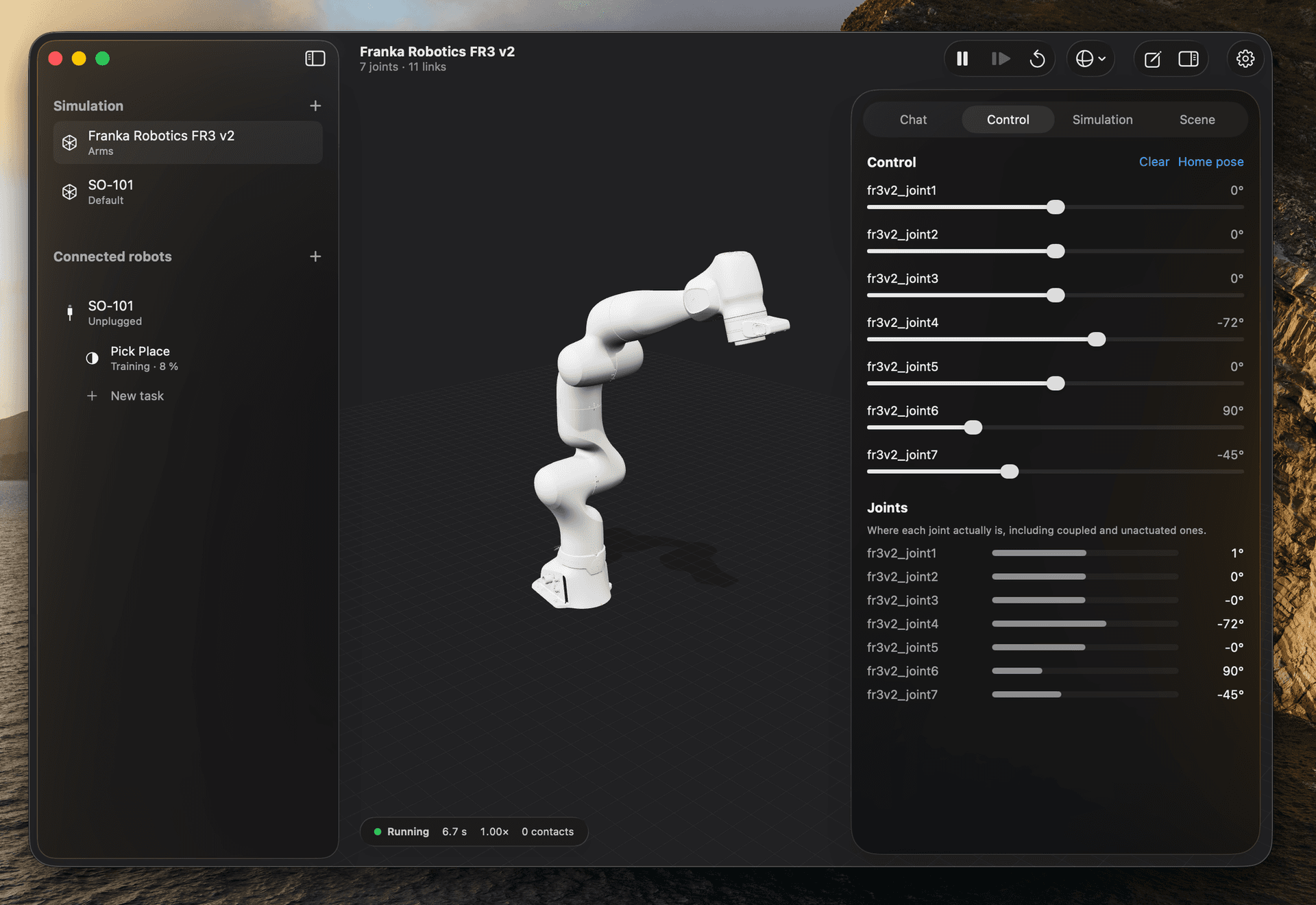
It's called Curiosity. A Mac app. When you open it, there are only two buttons: open a simulator, or connect your robot.
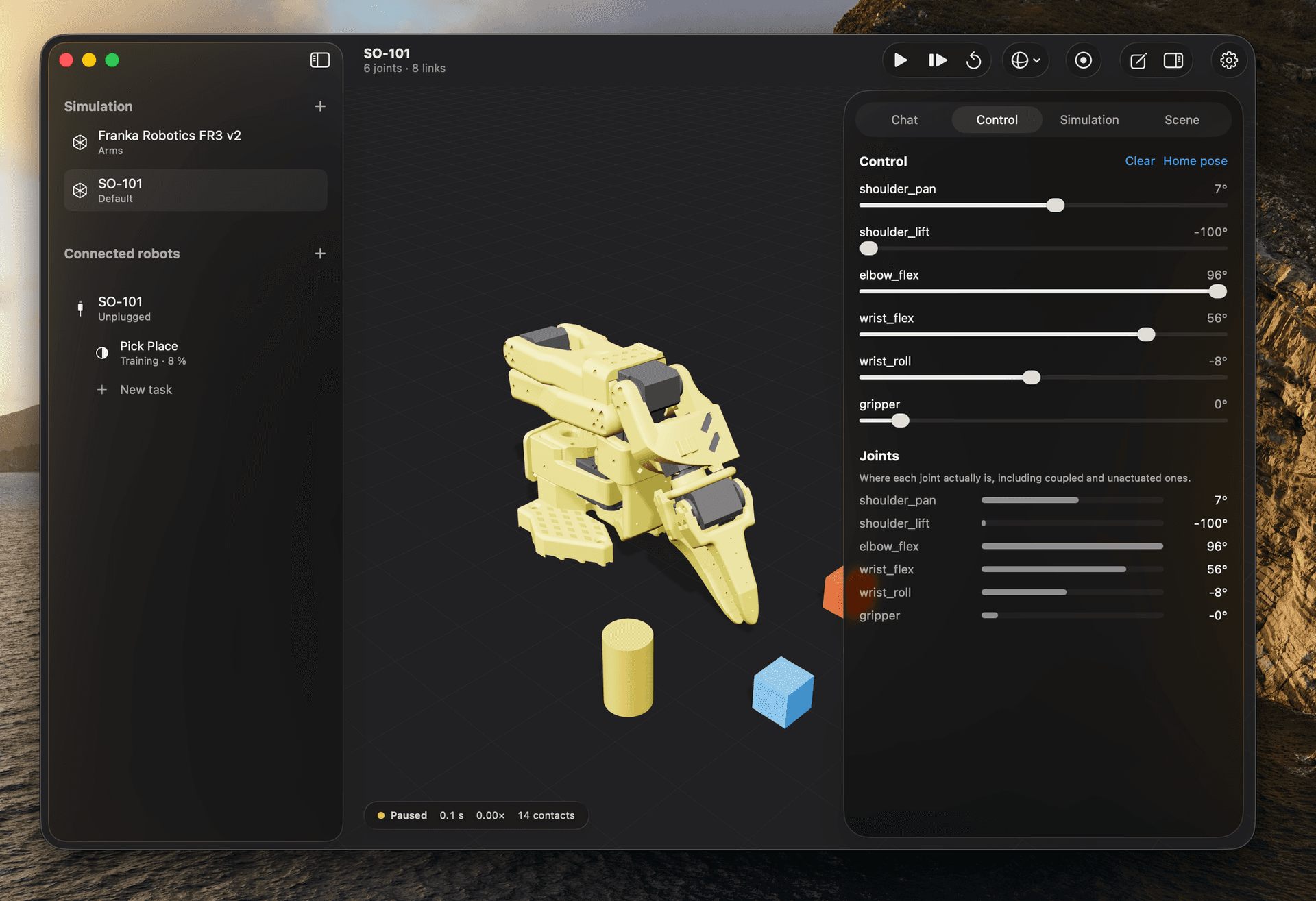
The same simulator loads other arms, like a Franka FR3, so you can try a robot before you own one.
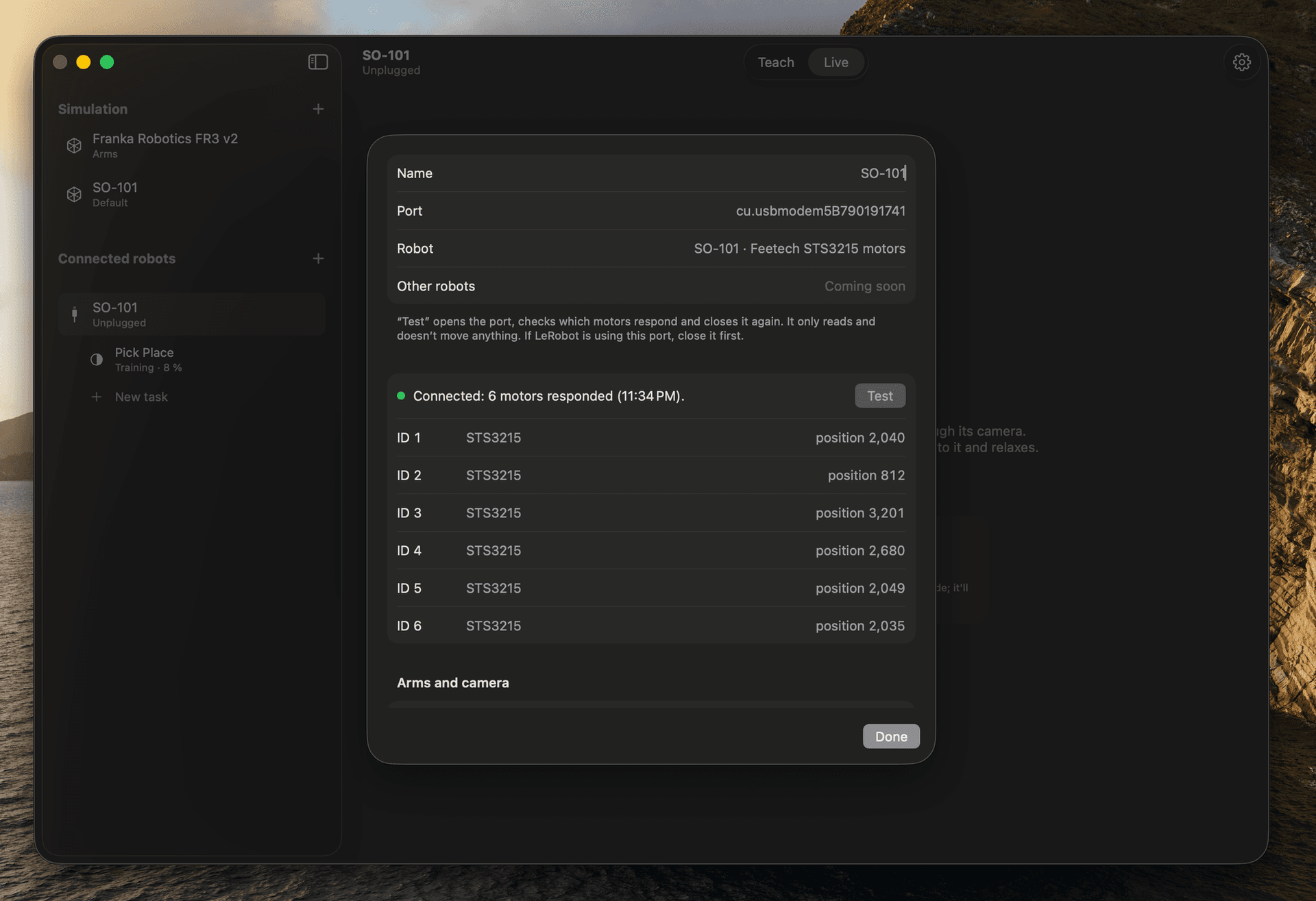
Plug in the USB. Curiosity checks for you: are the six motors answering, is it calibrated, do the cameras give an image.
Then you see it live: the wrist camera, a second camera on the table, a 3D model that moves with the real arm, and the same chat. The arm stays still. It only moves with the controls, or when you approve what the AI proposes.
Teach. You describe the task in one sentence. "Put the red cube in the cup." Then three steps on one screen: record a few demonstrations with the leader, train, test it on the robot.
Or don't record at all. Search Hugging Face for demonstrations other people already recorded with the same robot, and train with those.
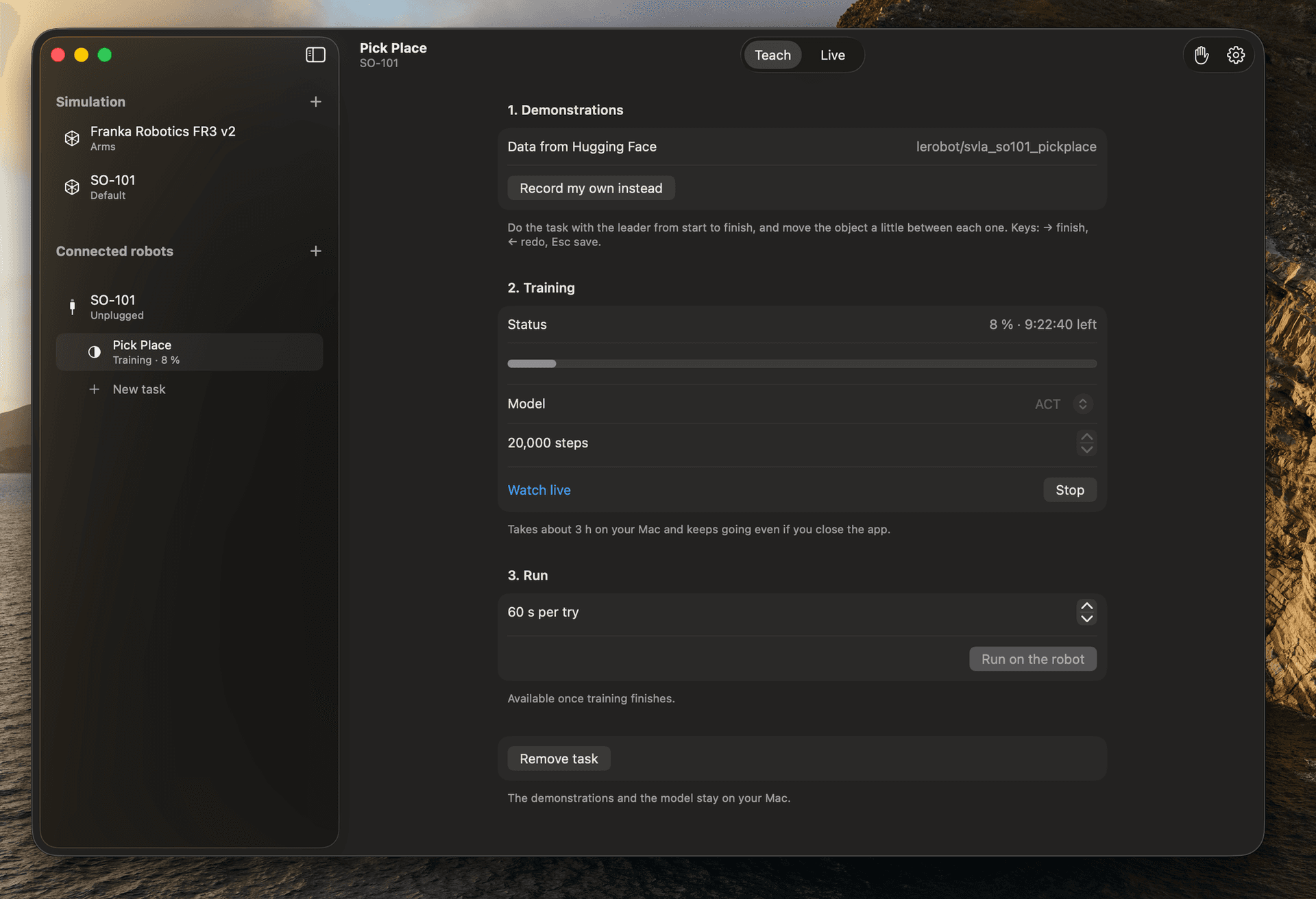
Every task, its data, and what the robot learned, in one place.
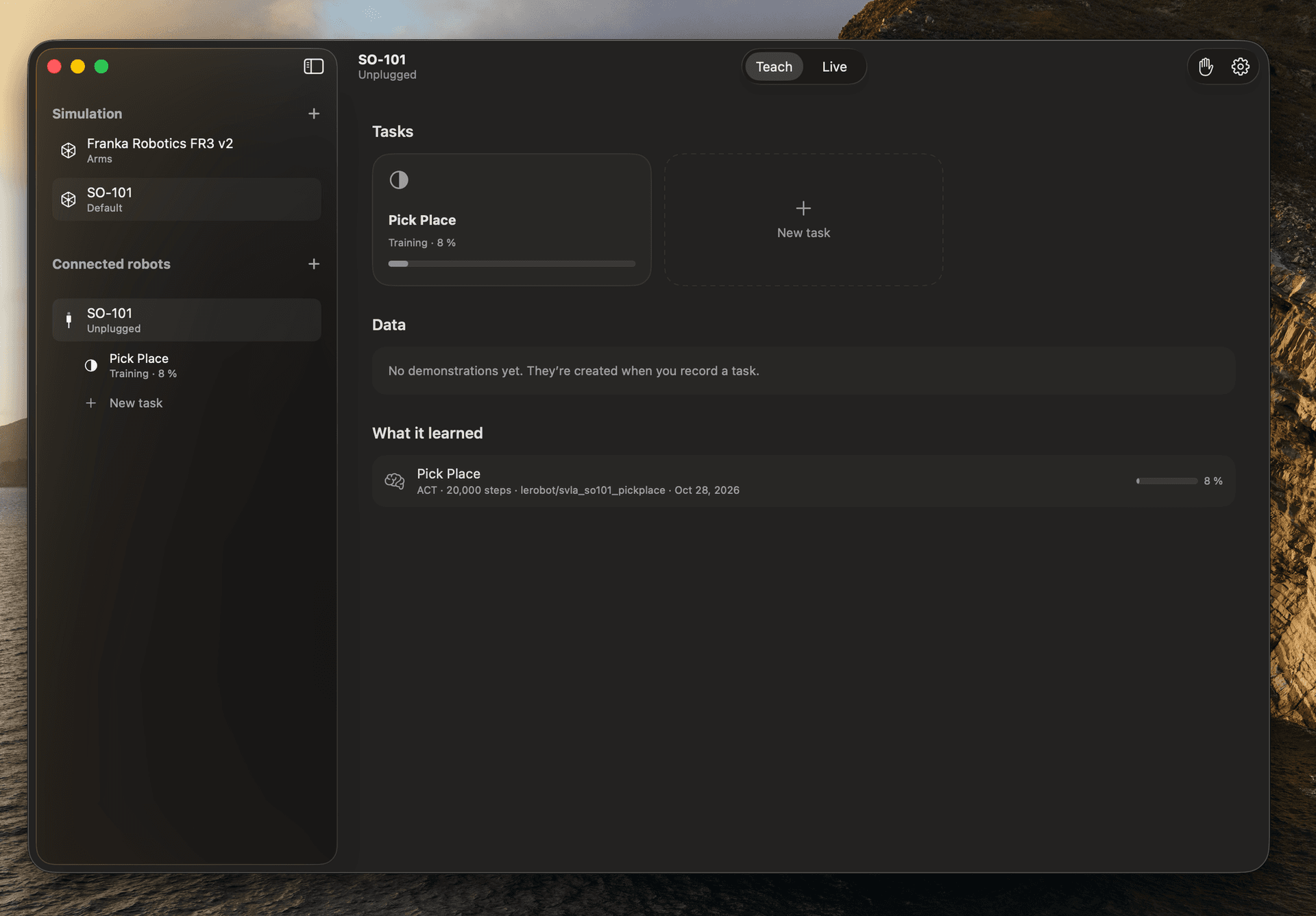
Nothing in it is new science. It runs on the same open-source tools I used in the terminal. That's the point. The science is there. The front door wasn't.
It's a start. The robot still can't finish my Jenga row.
Early or wrong
Here, the answer is clear. Billions are going into the brain. Very little is going into the front door.
That could mean I'm early. It could mean I'm wrong. So I'll use a simple test: ten people who aren't roboticists, teaching a robot something real, in one afternoon.
If they can, the door matters more than the field thinks. If they can't, the problem is still mostly in the model and the data, and I'll have learned that too.
In four days I learned that robots are hard.
Not all of the hard part is the part programmers know how to fix. But some of it is.